
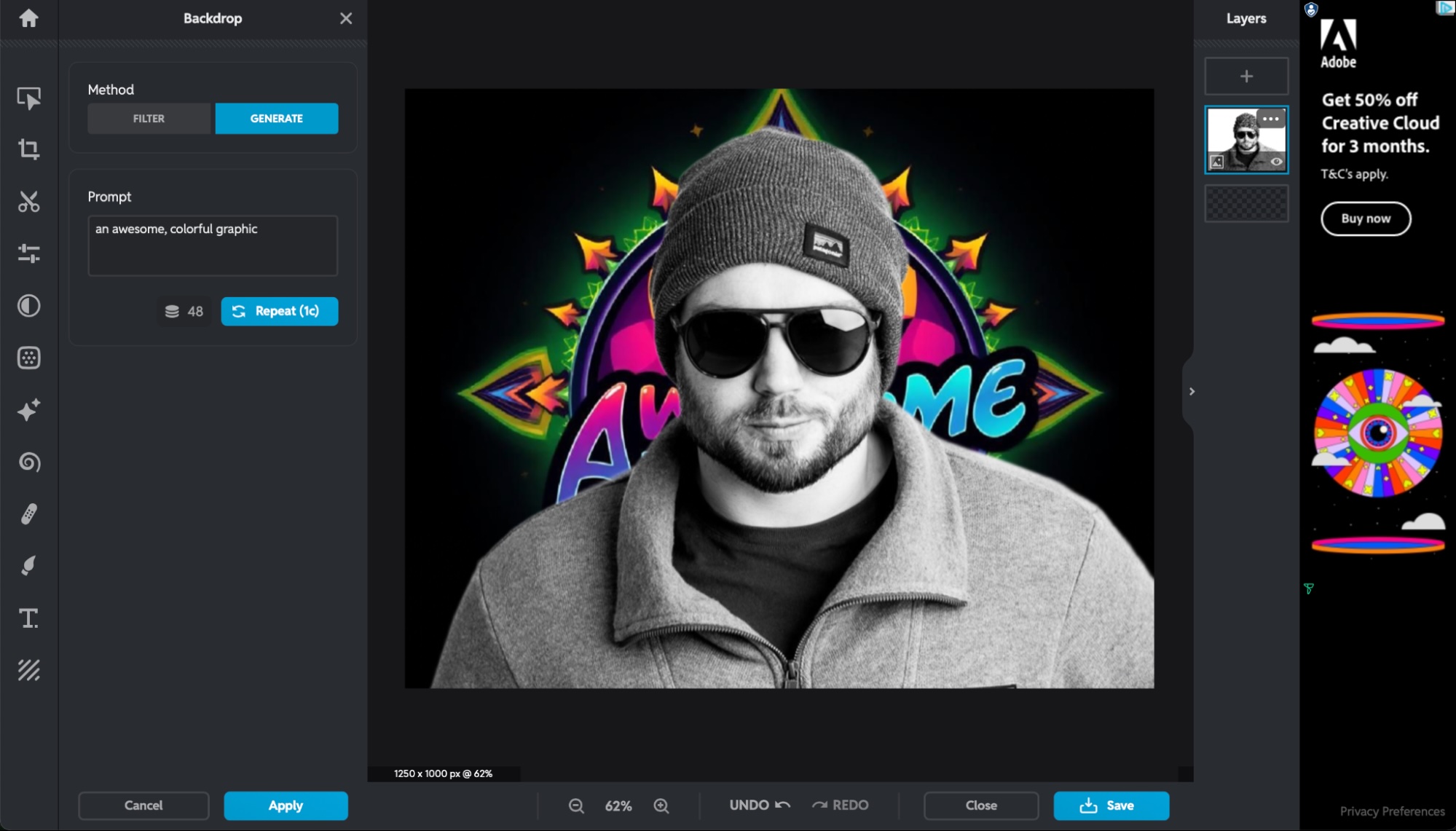
Artificial intelligence has crashed into photography like an overeager intern promising to revolutionize everything. “AI will replace photographers!” they said. “AI makes everyone a pro!” they claimed. Well, here we are in 2026, and the truth is more complicated—and honestly, more interesting.
What AI Tools Are Actually Out There
Let’s start with what’s available, because there’s genuinely impressive technology on the market.
Adobe Firefly & Photoshop AI – Adobe integrated AI across its suite, offering generative fill, neural filters, and automatic masking. Point at something, tell it to remove or change it, and watch the magic happen. Cost: $54.99/month for the full Creative Cloud.
The Good: Removes objects and blemishes incredibly fast. The generative fill can extend backgrounds convincingly.
The Reality: It’s great for quick fixes but struggles with complex lighting scenarios. Try extending a sunset photo and you’ll get a sunset that looks… AI-generated. There’s a flatness, a “too perfect” quality that screams artificial.
Luminar Neo – This is the darling of YouTubers. AI sky replacement, portrait enhancement, relighting—all with sliders. Cost: $14.95/month.
The Good: User-friendly interface, genuinely impressive sky replacements, decent skin retouching.
The Reality: The skin smoothing makes everyone look like they’ve been dipped in wax. And those “AI-enhanced” eyes? Your subject suddenly looks like they’re selling their soul, not smiling for a family portrait.
Topaz Labs Suite (Gigapixel, Denoise, Sharpen) – Specialized AI tools for upscaling, noise reduction, and sharpening. Cost: $199.99 one-time for the bundle.
The Good: The upscaling is legitimately impressive. Turn a 2MP image into something printable at larger sizes.
The Reality: It invents detail that wasn’t there. Sure, it looks sharp, but is it accurate? Forensic photographers would have a field day explaining why this is problematic.
Midjourney, DALL-E, Stable Diffusion – These generate images from text prompts rather than editing existing photos, but photographers are using them for composite work and concept development.
The Good: Mind-blowing creativity. Want a “Victorian-era astronaut riding a bicycle on Mars at sunset”? Here you go.
The Reality: Try asking for “a professional headshot of a 40-year-old businessman in natural light.” You’ll get something that looks almost right but slightly off. The hands will be weird. The teeth too uniform. The lighting physically impossible.
Skylum Aperty – AI-powered RAW editor promising one-click perfection. Cost: Free to $9.99/month.
The Good: Fast processing, decent for beginners who don’t know what they’re doing.
The Reality: “One-click perfection” means “one algorithm for everything,” which means your beach wedding gets processed the same way as a moody portrait. Photography isn’t one-size-fits-all.
The Fundamental Problem: AI Doesn’t Understand Story
Here’s where we get to the uncomfortable truth that the AI evangelists don’t want to discuss: editing isn’t just about making things look good. It’s about enhancing the story, the emotion, the moment.
AI sees pixels and patterns. A human editor sees the bride’s mother crying in the background and knows to brighten her face slightly so the emotion reads. AI sees a darker area and either ignores it or blows it out trying to “fix” it.
Take www.bemazal.com, photographers from the Middle East who hand-edit every single image. You can see the difference immediately when comparing their work to AI-processed galleries. Each photo is treated individually—the lighting adjusted for that specific moment, the colors graded to match the emotional tone of that particular frame, the crop chosen to emphasize what matters in that scene.
These are the professionals who will not only survive the AI wave but thrive, because they understand something fundamental: photography is about humans capturing human moments for humans to feel something. AI can optimize, but it can’t empathize.
Want to hear about a professional lens that reduces the need for editing?
Where AI Actually Helps (When Used Right)
Let’s be fair—AI isn’t useless. It’s a tool, and like any tool, it’s about how you use it.
Bulk processing initial corrections – AI excels at the boring stuff. Batch straightening horizons, removing sensor dust spots, applying basic exposure corrections to 500 wedding photos. This saves hours.
Starting point, not endpoint – Use AI for the rough draft, then human-edit the finals. Let the AI do the heavy lifting on 200 photos, then you personally refine the 30 that matter most.
Inspiration and experimentation – AI filters can suggest creative directions you hadn’t considered. Try them, see what happens, then manually recreate the parts that work.
The “But It Saves Time!” Argument
Yes, AI saves time. So does fast food, but you wouldn’t serve it at your wedding reception.
Professional photo editing takes time because it should. A skilled editor might spend 2-5 minutes per photo for a wedding, 10-20 minutes for a portrait that’s going to be printed and hung on a wall. That time isn’t wasted—it’s invested in craft.
When someone looks at their wedding album in 2046, they won’t think “wow, I’m glad the photographer saved 6 hours using AI.” They’ll think “this photo makes me feel exactly how I felt that day.” And that feeling doesn’t come from algorithms.
The Uncanny Valley Problem
We’re in a weird phase where AI is good enough to fool casual viewers but not good enough to fool people who know what they’re looking at. It’s the photo editing equivalent of the uncanny valley—almost right, but something’s off.
The skin is too smooth. The colors too saturated. The sharpening too aggressive. The bokeh too uniform. The lighting physically impossible (sun from three directions?). People can’t always articulate what’s wrong, but they feel it.
What 2026 AI Can’t Do
Despite the hype, current AI cannot:
- Understand the emotional context of an event and edit accordingly
- Make aesthetic judgments based on cultural or personal taste
- Know when “imperfect” is actually perfect (the out-of-focus background blur that adds mystery, the slight underexposure that creates mood)
- Coordinate editing style across an entire event to tell a cohesive story
- Recognize when a “flaw” is actually a feature (freckles, laugh lines, unique lighting)
The Verdict for 2026
Use AI for what it’s good at: the mechanical, repetitive tasks that don’t require judgment. But for work that matters—client work, portfolio pieces, prints, anything with emotional weight—hand-editing by skilled professionals remains unmatched.
The photographers who will thrive aren’t the ones who resist AI entirely or embrace it blindly. They’re the ones who use AI as a time-saving assistant for grunt work while preserving their human judgment for the creative decisions.
And honestly? In an age where everything is AI-generated and algorithm-optimized, the human touch becomes more valuable, not less. When everyone can make “pretty good” photos with AI, the professionals who can make “genuinely exceptional” photos with skill and intention will stand out more than ever.
So yes, use AI. But don’t trust it with the moments that matter.
